

Introduction
If your physiotherapist has recommended IFT physiotherapy, you may be wondering exactly what it involves and why it is used. IFT stands for Interferential Therapy, a widely used electrotherapy technique that helps relieve pain, reduce muscle spasm, and support recovery from a range of musculoskeletal conditions.
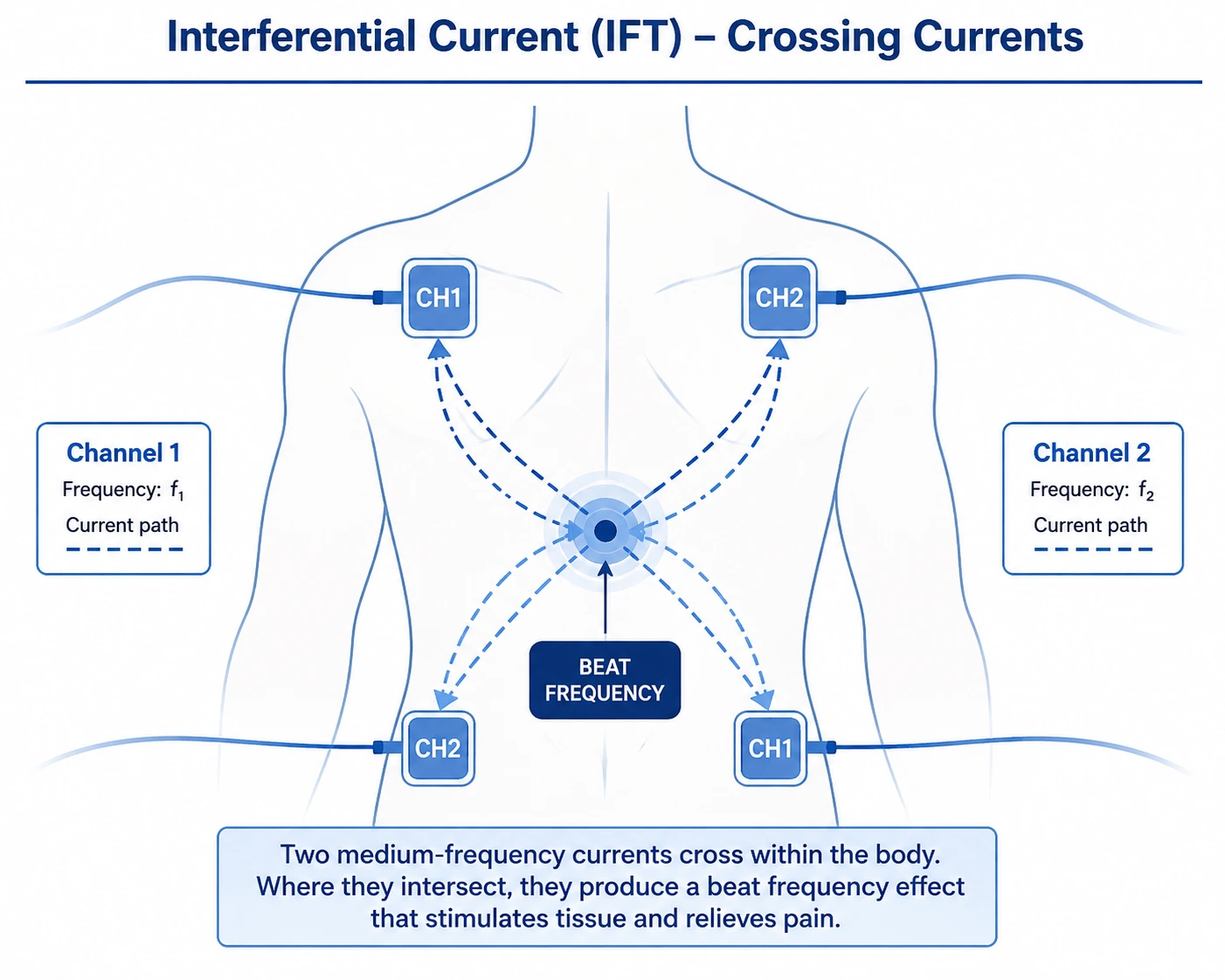
Interferential therapy works by passing two slightly different medium-frequency electrical currents through the body, which cross and interfere with each other at the site of pain. This guide explains what IFT in physiotherapy actually is, how it works, what conditions it treats, what a session feels like, and who should avoid it.
What Is IFT (Interferential Therapy)?
IFT, or Interferential Therapy, is a form of electrotherapy that uses electrical currents to relieve pain and support tissue healing. It is one of the most commonly used modalities in physiotherapy clinics, applied through electrode pads placed on the skin near the area of pain.
Unlike some electrotherapy techniques that rely on a single low-frequency current, IFT uses two separate medium-frequency currents that cross paths inside the body. This design allows the treatment to reach deeper tissues comfortably, without the unpleasant skin sensation that a single low-frequency current can cause.
How Does IFT Physiotherapy Work?
The principle behind IFT physiotherapy is straightforward once you understand the electrical concept. Two medium-frequency currents, each with a slightly different frequency, are passed into the body through separate pairs of electrodes.
For example, if one circuit carries a current at 4,000 Hz and the other at 3,980 Hz, the two currents interfere with each other where they cross inside the tissue. This crossing point produces a new, much lower frequency, known as the beat frequency, which in this example works out to 20 Hz.
This low beat frequency is what actually produces the therapeutic effect, stimulating nerves and tissue at a depth that a low-frequency current alone would struggle to reach comfortably. Medium-frequency currents pass through the skin with less resistance than low-frequency currents, which is why IFT can deliver a therapeutic low-frequency effect deep in the tissue while feeling far more comfortable on the skin’s surface.
Part of the pain relief from IFT is also believed to come from the body’s own response to the stimulation, including the release of endogenous opioids such as endorphins, which help reduce the sensation of pain.
What Does an IFT Session Feel Like?

During a session, your physiotherapist places electrode pads on or around the painful area, positioned so the currents cross exactly where treatment is needed. Most patients describe the sensation as a mild tingling or gentle pulsing feeling, rather than pain.
Sessions are generally comfortable, and your physiotherapist will adjust the intensity based on your feedback throughout the treatment. If you ever feel sharp pain, burning, or unusual discomfort, tell your physiotherapist immediately so the settings or electrode placement can be adjusted.
A typical IFT session lasts around 10 to 20 minutes, and treatment is usually spread across multiple sessions rather than a single visit, since the effects build progressively over a course of treatment.
Conditions IFT Physiotherapy Treats
IFT is used across a wide range of musculoskeletal and pain-related conditions. Common uses of interferential therapy include chronic back pain, neck pain, and shoulder pain, sciatica, osteoarthritis and joint pain, tendonitis, frozen shoulder, muscle spasm, and swelling or edema following injury or surgery.
It is also commonly used for post-traumatic and post-surgical pain, helping patients manage discomfort during recovery without relying solely on oral pain medication. Because IFT can reach deeper muscle and joint tissue comfortably, it is particularly useful for chronic musculoskeletal pain that has not responded well to surface-level treatments.
How Many IFT Sessions Are Needed?
The number of sessions needed depends on your specific condition, its severity, and how you respond to treatment. As a general guide, IFT is typically applied over 6 to 12 sessions across several weeks, though your physiotherapist will tailor this to your individual recovery goals.
Many patients begin to notice some relief within the first few sessions, though full benefit usually builds gradually over the full course of treatment.
IFT vs TENS: What’s the Difference?
IFT and TENS (Transcutaneous Electrical Nerve Stimulation) are both electrotherapy techniques used for pain relief, and patients sometimes confuse the two. TENS primarily targets nerves close to the skin’s surface, offering more temporary, superficial relief.
IFT physiotherapy, by contrast, is designed to reach deeper muscle layers and joints because of how its two currents interact inside the tissue. This makes IFT especially useful for managing chronic pain and deeper musculoskeletal issues, while TENS is often used for more immediate, surface-level pain relief.
Are There Side Effects or Risks?
IFT is generally considered a safe, non-invasive treatment when administered by a trained physiotherapist. However, it is not suitable for everyone, and certain situations call for caution or avoidance altogether.
You should not receive IFT if you have a pacemaker or other implanted electronic device, since the electrical currents can interfere with how these devices function. It is also generally avoided during pregnancy, in patients with cancer or a known malignant tumor near the treatment area, active infection, deep vein thrombosis, arterial disease, or epilepsy, and should not be applied over the eyes, the front of the neck, or directly over the heart.
Patients who cannot clearly communicate discomfort, such as those with certain cognitive or sensory impairments, generally should not receive IFT without extra caution and close supervision. This is not a complete list of every contraindication. Always share your full medical history with your physiotherapist before starting treatment, so they can confirm IFT is appropriate and safe for you specifically.
When to Talk to a Physiotherapist About IFT
If you are dealing with ongoing back pain, neck pain, joint pain, or recovering from a recent injury or surgery, it is worth asking your physiotherapist whether IFT physiotherapy is a suitable option for your specific condition. A qualified physiotherapist will assess your condition, confirm there are no contraindications, and determine the right treatment frequency and electrode placement for your needs.