
Introduction
If you have ever felt anxious about being slid into a narrow MRI tube, you are not alone. Open MRI is a scanning option designed specifically to make this experience easier, and understanding what it is can help you make a more informed choice before your next scan.
An open MRI is a type of magnetic resonance imaging machine built without the long, enclosed tunnel of a traditional scanner.
Instead of a tube, an open MRI uses a more spacious design, with open sides or a wider opening, so you are not fully enclosed during the scan.
This guide explains how open MRI works, its benefits, how it compares to a closed MRI, and who it is best suited for.
What Is an MRI Scan?
Magnetic Resonance Imaging, or MRI, is a diagnostic tool that uses magnetic fields and radio waves to create detailed images of the inside of the body.
Unlike an X-ray, MRI does not use radiation, and it is especially good at capturing soft tissue, making it valuable for evaluating the spine, discs, nerves, and joints.
A traditional MRI machine, often called a closed MRI, looks like a long tube. The patient lies on a table that slides into this tunnel while the scan is performed.
For many patients, this works without any issue. For others, spending several minutes inside a narrow enclosed space can trigger significant discomfort or anxiety.
What Is an Open MRI Machine?
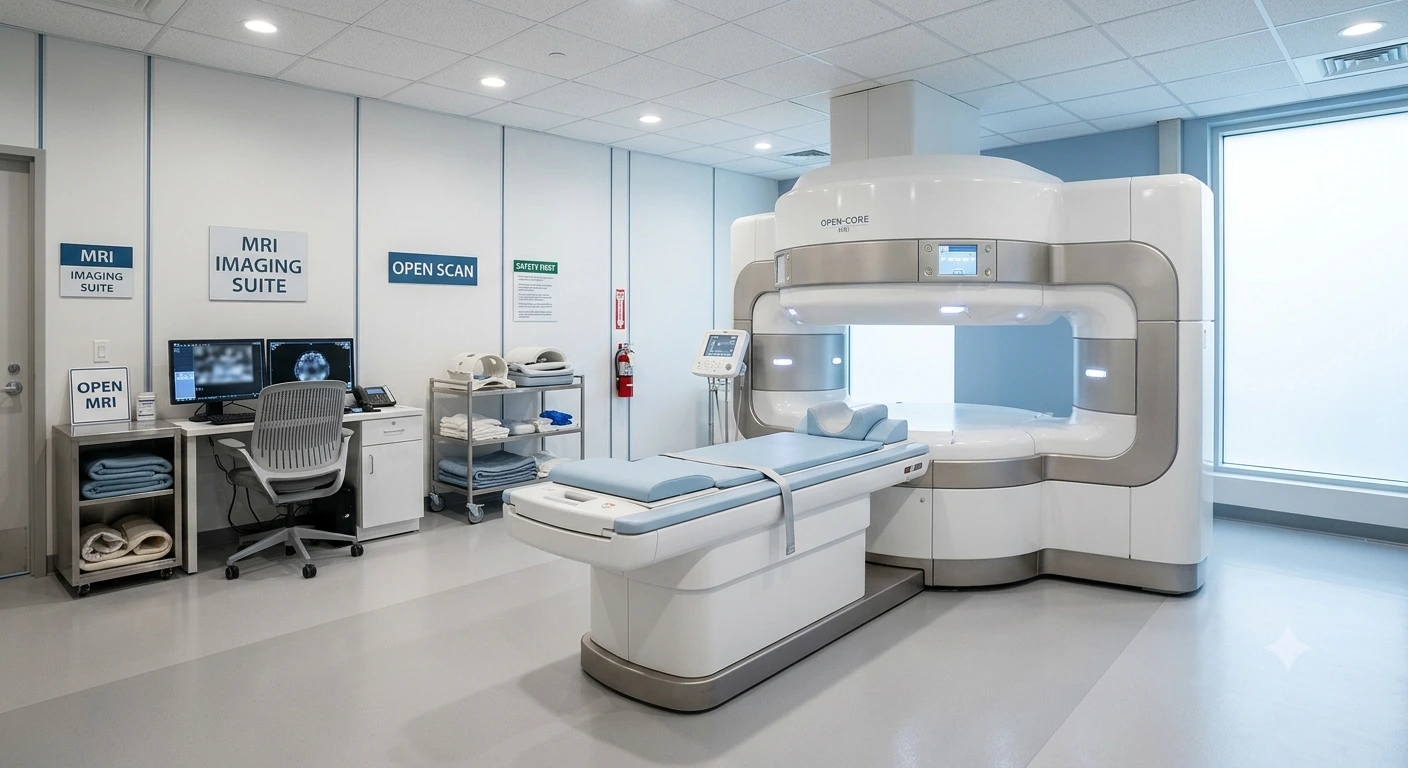
An open MRI machine is designed to reduce that enclosed feeling.
Rather than a full tunnel, the machine has open sides, a wider bore, or in some designs, no tunnel at all, allowing more visible space around the patient during the scan.
Some open MRI machines use a C-shaped or box-like structure with open sides, while more advanced versions allow scanning while the patient is sitting or standing.
The magnetic and imaging technology inside an open MRI machine works on the same basic principles as a closed MRI. The difference is in the design of the space around the patient, not in the underlying imaging technology itself.
Open MRI vs Closed MRI: Key Differences
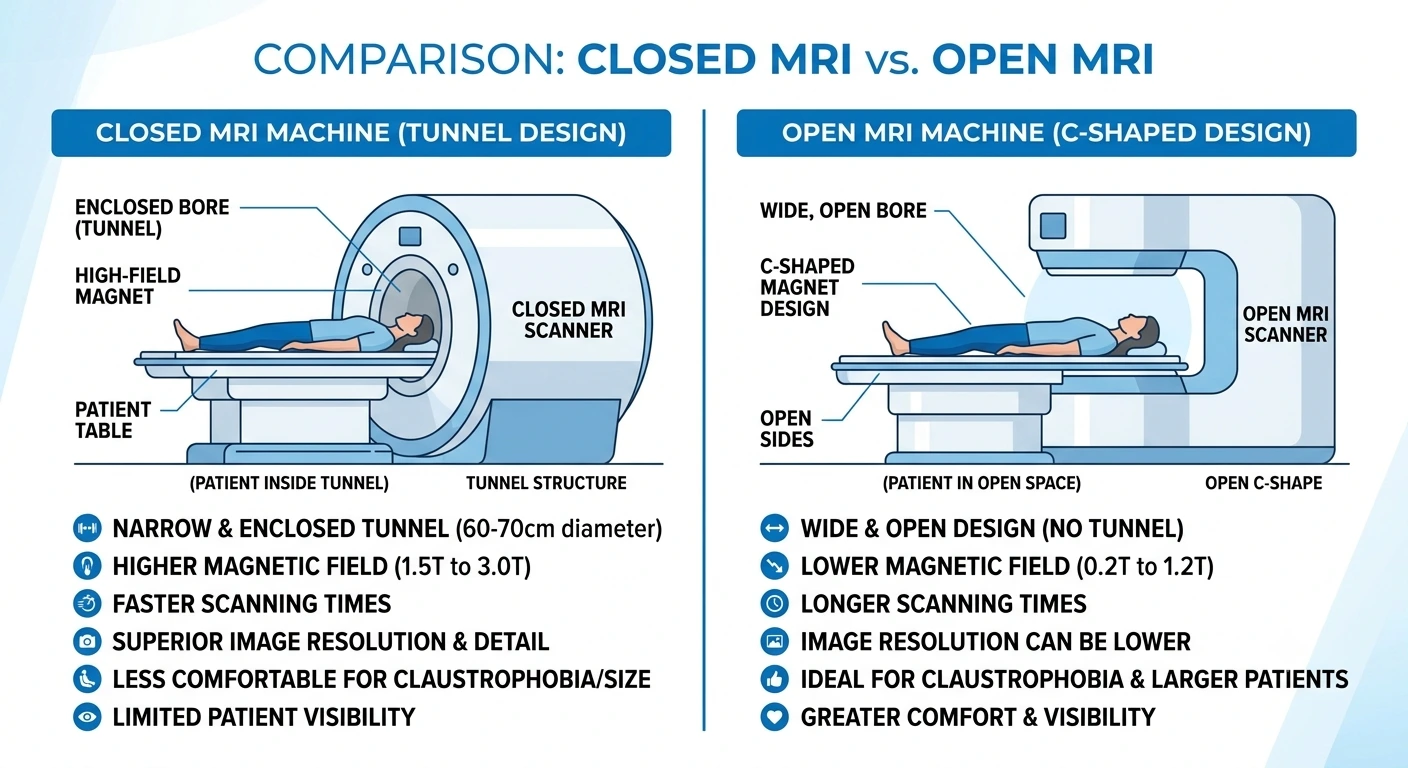
The main technical difference comes down to magnetic field strength, measured in Tesla (T). Closed MRI machines typically operate between 1.5T and 3.0T, while open MRI machines generally range from 0.3T to 0.7T, with some newer high-field open systems reaching up to 1.2T.
A stronger magnetic field generally means sharper, more detailed images, which is why closed MRI is often still preferred for highly complex diagnostic needs such as detailed neurological imaging.
Modern high-field open MRI systems have narrowed this gap considerably, and for most spine, joint, and general diagnostic needs, they now produce clinically accurate images.
Scan time can also differ, since machines with stronger magnets often complete a scan faster than lower-field open MRI models.
For patients who are significantly overweight, a closed MRI’s narrow tunnel may simply not accommodate them comfortably, making an open MRI machine a practical necessity rather than just a comfort preference.
Benefits of Open MRI
The most well-known benefit of an open MRI is comfort for people who feel claustrophobic. Without a narrow tunnel surrounding them, many patients feel considerably calmer during the scan.
This matters clinically, not just emotionally. A patient who is anxious or unable to stay still is more likely to move during the scan, which can blur the images and require a repeat scan.
An open MRI machine also benefits larger patients, since the wider design and higher weight limits on many open systems can accommodate body sizes that would not fit comfortably in a standard closed MRI tunnel.
Some open MRI designs allow scanning in a seated or standing position. This is particularly useful for the spine, since it can show how the spine behaves under normal, weight-bearing conditions rather than only lying flat.
Children and elderly patients, who may struggle to stay still or feel anxious in an enclosed space, often tolerate an open MRI scan more easily as well.
Who Should Consider an Open MRI?
An open MRI is worth discussing with your doctor if you have a history of claustrophobia or significant anxiety around enclosed spaces.
It is also a reasonable option if your body size makes a standard closed MRI tunnel physically uncomfortable or difficult to fit into.
Patients who need a weight-bearing or positional scan, such as certain spine conditions where standing or sitting imaging gives more diagnostic information, may specifically benefit from a standing or seated open MRI machine.
Parents scheduling a scan for a young child, or family members arranging one for an elderly relative with mobility or anxiety concerns, often find open MRI a more manageable experience for everyone involved.
That said, not every case is straightforward. Certain complex spine or neurological conditions may still require the higher-field detail of a closed MRI, so this is always a conversation to have with your treating doctor first.
Preparing for an Open MRI Scan
Preparation for an open MRI is largely the same as for any MRI. You will typically be asked to remove metal objects, jewelry, and anything magnetic before the scan.
Let the technician know about any implants, prior surgeries, or medical devices in your body, since certain metal implants can affect MRI safety and image quality.
Depending on the area being scanned, you may or may not need to change into a gown. Your doctor’s office or the imaging center will give you specific instructions ahead of time.
The scan itself is painless. You may hear knocking or humming sounds from the machine, which is normal.
Where to Get an Open MRI
Open MRI machines are available at select imaging centers and hospitals across India, though availability varies by city and is still less common than standard closed MRI.
If claustrophobia, body size, or a positional scan is a concern for you, it is worth asking your doctor or referring physician which imaging centers in your area offer open MRI, and whether it is appropriate for your specific diagnostic needs.
Your spine specialist can help determine whether an open MRI, a closed MRI, or another imaging approach is the right fit for accurately diagnosing your condition.