
Introduction
If your doctor mentioned a herniated disc, but your pain feels like sciatica, you are not alone in the confusion. Many patients use these two words as if they mean the same thing.In the sciatica vs herniated disc discussion, the short answer is this: sciatica is a symptom, and a herniated disc is one of its possible causes.
Sciatica describes pain that travels along the sciatic nerve, usually from the lower back down through the hip and leg. A herniated disc is a physical, structural problem the soft cushion between two spinal bones pushes out of place. When that disc presses on a nearby nerve root, it can trigger sciatica.
Understanding this cause-and-symptom relationship helps you ask the right questions and get the right treatment, instead of guessing. This guide breaks down what each term actually means, how they connect, and when a herniated disc is not to blame at all.
What Is Sciatica?
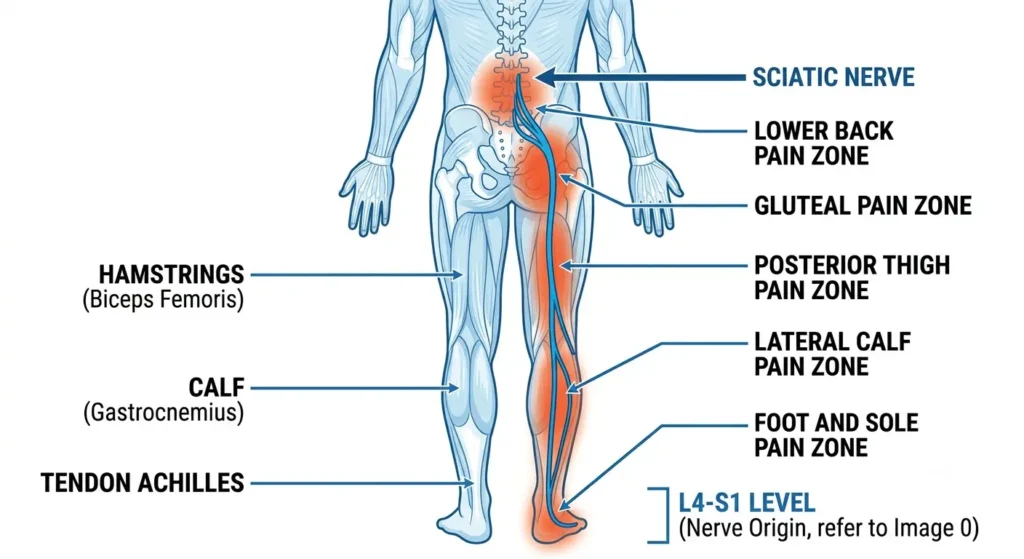
Sciatica is not a disease. It is a set of symptoms caused by irritation or compression of the sciatic nerve, the longest nerve in the body.The sciatic nerve runs from the lower back, through the buttock, and down the back of each leg.
When something presses on this nerve, it produces a distinct pattern of pain. Most people describe it as a sharp, burning, or shooting sensation that travels down one leg, often paired with numbness or tingling.
Sitting for long periods, coughing, or sneezing can make sciatica pain worse.
Several conditions can cause sciatica, and a herniated disc is only one of them.Spinal stenosis, piriformis syndrome, and degenerative disc disease can also compress or irritate the sciatic nerve and produce identical symptoms.
What Is a Herniated Disc?
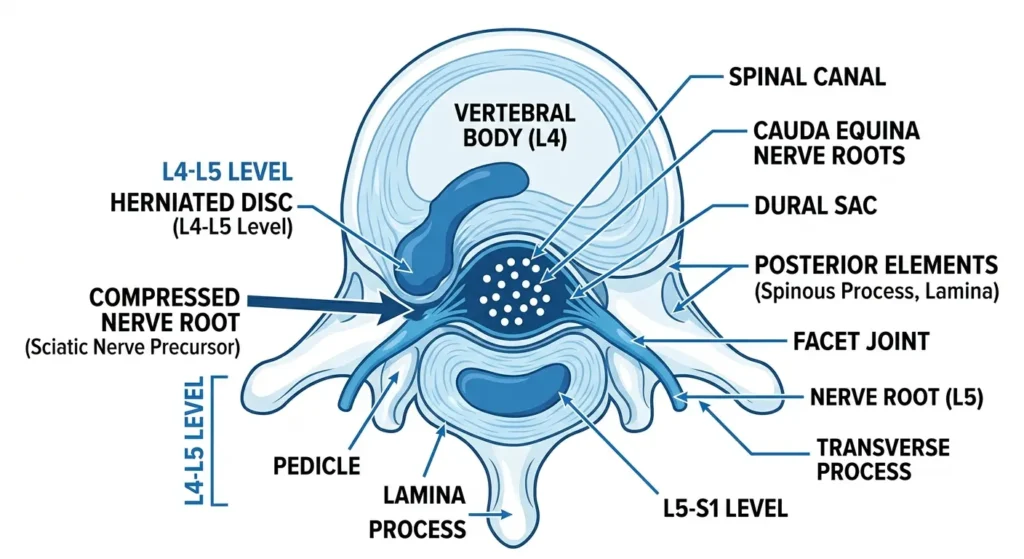
A herniated disc, sometimes called a slipped disc or ruptured disc, is a structural injury to one of the rubbery cushions (discs) between the bones of your spine.Each disc has a soft, gel-like center surrounded by a tougher outer layer.When the outer layer weakens or tears, some of the soft center pushes outward.
When the outer layer weakens or tears, some of the soft center pushes outward.
This bulge or leak can happen anywhere along the spine, most commonly in the lower back (lumbar spine), particularly at the L4-L5 or L5-S1 levels.
A herniated disc does not always cause pain. Many people carry one without ever knowing, discovered only incidentally during an MRI for an unrelated issue.
It becomes a problem specifically when the herniated material presses against a nearby nerve root.
How They’re Related: Cause vs Symptom
Here is the relationship in one sentence: sciatica is what you feel, and a herniated disc is often what causes it. When a herniated disc in the lower spine pushes against the sciatic nerve root, it produces the classic radiating leg pain we call sciatica.
But the connection is not automatic in either direction.
Not every herniated disc causes sciatica, and not every case of sciatica comes from a herniated disc.
This is the single most misunderstood part of the sciatica vs herniated disc comparison, and it is worth remembering before you assume one always means the other.
Sciatica vs Herniated Disc: Key Differences
| Aspect | Sciatica | Herniated Disc |
|---|---|---|
| Definition | A symptom nerve pain radiating along the sciatic nerve pathway. | A structural condition displaced disc material in the spine. |
| Primary Cause | Nerve compression or irritation from various sources. | Wear, injury, or age-related weakening of the disc’s outer layer. |
| Typical Location of Pain | Lower back, buttock, and down one leg, sometimes to the foot. | Localized back pain, which may or may not radiate depending on nerve involvement. |
| Can Exist Without the Other | Yes can result from spinal stenosis, piriformis syndrome, or other causes. | Yes many herniated discs are asymptomatic and never cause sciatica. |
| Diagnosis Method | Physical exam, straight leg raise test, and symptom pattern. | MRI or CT scan to confirm disc position and nerve contact. |
| Typical First-Line Treatment | Rest, physical therapy, anti-inflammatory medication, and nerve-focused exercises. | Physical therapy, activity modification, and time; imaging-guided treatment if severe. |
Other Causes of Sciatica
A herniated disc is a common cause of sciatica, but it is not the only one.
Spinal stenosis, a narrowing of the spinal canal that puts pressure on nerves, frequently causes similar leg pain, especially in older adults.
Piriformis syndrome, where a muscle deep in the buttock irritates the sciatic nerve, can mimic disc-related sciatica closely enough to confuse a self-diagnosis.
Degenerative disc disease, spondylolisthesis, and, rarely, spinal tumors can also produce sciatic nerve symptoms.
This is exactly why a proper diagnosis matters more than guessing based on symptoms alone.
Symptoms Comparison
| Aspect | Sciatica | Herniated Disc |
|---|---|---|
| Primary Symptoms | Shooting or burning pain down one leg, numbness, tingling, and sometimes weakness in the foot or leg. | Symptoms depend on whether the disc is compressing a nerve. |
| Pain Pattern | Usually one-sided and follows the sciatic nerve pathway from the lower back to the leg. | May cause only localized back stiffness or dull aching if no nerve is involved. |
| When Nerves Are Involved | Symptoms are caused by irritation or compression of the sciatic nerve. | If the herniated disc compresses a nerve, symptoms become the same as sciatica. |
How Each Is Diagnosed
| Aspect | Sciatica | Herniated Disc |
|---|---|---|
| Primary Diagnosis | Physical examination and symptom evaluation. | MRI to confirm the herniated disc and assess nerve involvement. |
| Common Tests | Straight leg raise test, reflex testing, muscle strength assessment, and sensation testing. | MRI (preferred) or CT scan if MRI is not suitable. |
| Purpose of Testing | Identify the affected nerve root based on symptoms and physical findings. | Determine the location and severity of the disc herniation and whether it is compressing a nerve. |
| Additional Testing | May include nerve conduction studies if needed. | Nerve conduction studies can help confirm the affected nerve and assess severity, especially before surgery. |
Treatment Differences
| Aspect | Sciatica | Herniated Disc |
|---|---|---|
| First-Line Treatment | Rest from aggravating activities, physical therapy, anti-inflammatory medication, and targeted exercises (such as the McKenzie Method). | Rest from aggravating activities, physical therapy, anti-inflammatory medication, and targeted exercises (such as the McKenzie Method). |
| Conservative Care | Often improves symptoms regardless of the underlying cause. | Conservative care is effective for most herniated disc cases and often relieves associated sciatica. |
| When Treatment Changes | If symptoms persist, treatment depends on the underlying cause (e.g., piriformis syndrome, spinal stenosis). | If symptoms persist or nerve damage is suspected, treatment may progress to epidural steroid injections or, in selected cases, a microdiscectomy. |
| Treatment Focus | Targets the source of sciatic nerve irritation or compression. | Focuses on relieving pressure from the herniated disc and reducing nerve compression. |
When to See a Doctor
Most sciatica improves within four to six weeks with conservative care.
However, certain symptoms need prompt medical attention rather than a wait-and-see approach.
See a spine specialist without delay if you experience sudden loss of bladder or bowel control, numbness in the groin or inner thighs (saddle anesthesia), progressive leg weakness, or pain following a significant injury.
These can signal cauda equina syndrome, a rare but serious condition requiring urgent care.
If your pain persists beyond six weeks despite rest and physical therapy, or keeps returning, it is time for a proper evaluation and imaging rather than continued guesswork.