
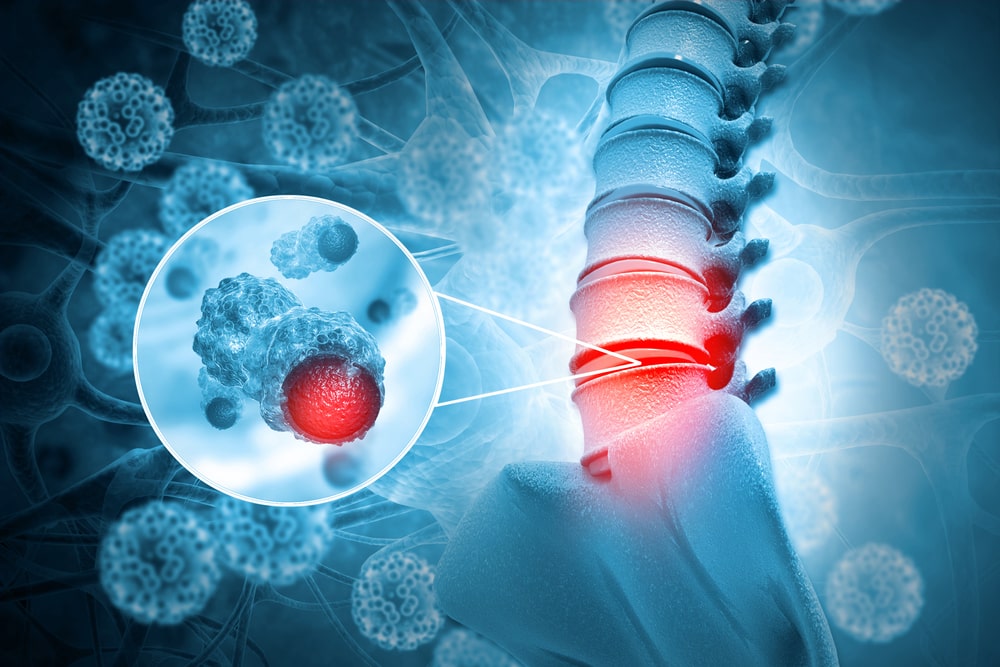
A thoracolumbar spine tumor is an abnormal growth (mass) of cells within or surrounding your spinal cord and/or spinal column. Your spine (backbone) is a long, flexible column of bones that protects your spinal cord. It starts at the base of your skull and extends down to your tailbone, which is a part of your pelvis. Your spinal cord contains nerve bundles and cells that carry messages from your brain to the rest of your body and from your body to your brain.
Thoracolumbar spine tumors can be located in several areas:
- Intramedullary: Inside of your spinal cord.
- Intradural-extramedullary: In the tissues (meninges) covering your spinal cord.
- Extradural: Between the meninges and bones of your spine.
- Vertebral: In the bony vertebrae of your spine.
Spinal tumors may be benign (non-cancerous) or malignant (cancerous). If the tumors continue to develop, they may cause harm to various tissues in your spinal column. Primary spinal tumors are those that develop first in the spine or spinal cord. Metastatic, or secondary, spinal tumors rs occur when cancer spreads from another part of your body to your spine. Compared to primary spinal tumors, metastatic spinal tumors occur far more commonly.
Nature of Spinal Tumors
Spinal tumors can be:
- Benign (noncancerous): These tumors are not cancerous and grow more slowly.
- Malignant (cancerous): These tumors are cancerous and can grow quickly, potentially causing more damage.
Diagnosis of Thoracolumbar Spine Tumor Surgery
- Medical Examination: Focus on back pain and neurological deficits.
- Radiological Tests: X-ray, CT Scan (Computed Tomography) and MRI (Magnetic Resonance Imaging)
- Biopsy: Confirms if the tumor is benign or malignant and determines cancer type for treatment planning.
View this post on Instagram
Who Gets Spinal Tumors?
Anyone can develop a spinal tumor, but they are more likely in people with cancer, especially lung, breast, and prostate cancers, which are considered metastatic. Primary spinal tumors are rare and are more likely to occur in adults aged 65 to 74 and children aged 10 to 16.
Types of Spinal Tumors
Several types of spinal tumors include:
- Astrocytoma: Tumors of supporting cells inside the spinal cord; can be benign or malignant.
- Chordoma: Rare malignant tumors in the spine and skull, often at the base of the spine or tailbone.
- Ependymoma: Tumors in the lining of spinal fluid passageways in the brain and spinal cord.
- Glioblastoma: Aggressive malignant tumors from astrocytes in the spinal cord and brain.
- Hemangioblastoma: Tumors from blood vessels connected to the central nervous system.
- Meningioma: Tumors of the tissue covering the spinal cord and brain; usually benign.
- Neurofibroma: Benign tumors on nerves in the spinal column, often linked to a genetic disorder.
- Osteosarcoma: Bone cancer that can originate in the spine, more common in thigh and shin bones.
- Schwannoma: Tumors of cells surrounding nerve fibers; often benign.
- Spinal Hemangioma: Tumors from blood vessel tissues in the spinal column; most common and usually benign.
Understanding spinal tumors, their types, symptoms, and diagnostic processes can help in early detection and treatment, improving the prognosis for those affected.
Involvement of Healthcare Specialists
Treatment for thoracolumbar spine tumors treatment in Ahmedabad is highly individualized and involves a multidisciplinary team, including:
- Neurologists
- Spinal surgeons
- Medical oncologists
- Radiation oncologists
- Orthopaedists
- Urologists
- Vascular surgeons
Goals of Treatment
- Relieve pain.
- Maintain or improve spine and spinal nerve function.
- Improve quality and length of life.
- Remove tumors causing symptoms when possible.
Additional Treatment Options
- Stereotactic Radiosurgery: A nonsurgical procedure delivering precise radiation beams to the tumor, minimizing exposure to surrounding tissues.
- Vertebroplasty/Kyphoplasty: Minimally invasive procedures where bone cement is injected into the spine after tumor removal to provide support and stability, improve mobility, and relieve pain.
View this post on Instagram
Expert Thoracolumbar Tumor Care
If you or a loved one is experiencing symptoms of a spinal tumor, it’s essential to seek medical advice promptly. Contact IndoSpine at info@indospine.in or call 09978944981 to consult with expert spine specialists and explore the best treatment options tailored to your needs.