
Introduction
“Doctor, how long until I’m back to normal?” This is one of the first questions almost every patient asks after a herniated disc diagnosis. The honest answer depends on whether you’re healing without surgery or recovering after a procedure – and the biology behind each path follows a fairly predictable pattern.
This guide walks you through the complete herniated disc recovery timeline both non-surgical and post-surgery – so you know exactly what’s happening inside your spine at each stage, what’s normal, and what warning signs mean you should call your doctor.
Why Recovery Timelines Differ From Patient to Patient
A herniated disc occurs when the soft inner material of a spinal disc pushes through a tear in its tougher outer layer, irritating nearby nerves. Recovery speed depends on the size of the herniation, whether the disc material remains contained or has broken completely free, its exact location in the spine, and how the body’s own healing response reacts.
This is why two patients with a seemingly similar diagnosis can have very different recovery timelines. Age, overall fitness, and how consistently you follow physiotherapy also play a major role in how fast you heal.
Non-Surgical Recovery: The 3 Biological Phases of Healing
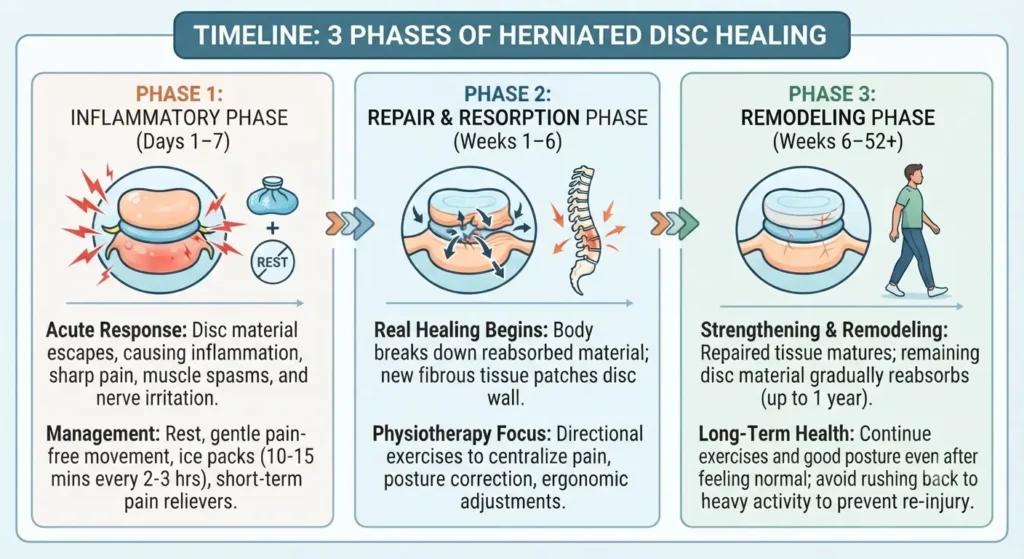
Most herniated discs heal without surgery. Studies show 80-90% of patients with acute herniated discs experience significant relief within 6 to 12 weeks of conservative treatment, according to NCBI’s clinical review on lumbar disc herniation. The body follows a natural, three-phase healing process to get there.
Phase 1: The Inflammatory Phase (Days 1-7)
When the disc’s outer layer tears, the escaped material triggers a local inflammatory response. This is what causes the sharp pain, muscle spasm, and nerve irritation in the first days. This phase is uncomfortable but necessary – it’s the body’s way of beginning the healing process.
During this window, rest combined with gentle, pain-free movement is recommended rather than strict bed rest. Ice packs applied for 10-15 minutes every 2-3 hours help reduce acute inflammation, and doctors commonly prescribe short-term pain relievers or muscle relaxants to manage symptoms.
Phase 2: The Repair and Resorption Phase (Weeks 1-6)
This is where real healing begins. The body starts breaking down and reabsorbing the displaced disc material, while new fibrous tissue forms around the torn area to patch the disc’s outer wall. Physiotherapy typically starts here, focused on directional exercises that encourage pain to “centralize” – meaning it retreats from the leg or arm back toward the spine, a genuinely good sign of healing.
If pain instead spreads further down the limb (called peripheralization), that’s a signal to stop the exercise and consult your doctor. Posture correction and ergonomic adjustments at work and home become important during this phase, and most patients notice steady, gradual improvement in both pain and mobility.
Phase 3: The Remodeling Phase (Weeks 6-52 and beyond)
By this stage, most patients feel functionally normal – walking, sitting, and working comfortably. But the disc itself is still quietly healing underneath: repaired tissue continues strengthening, and the body continues gradually reabsorbing any remaining disc material, a process that can continue for up to a year in some cases.
This explains something patients often don’t realize – you can feel completely fine weeks or months before your disc has fully finished healing internally. That’s exactly why continuing exercises and posture habits even after the pain disappears matters for long-term spine health, and why rushing back into heavy activity too soon raises the risk of re-injury.
Signs Your Recovery Is on Track
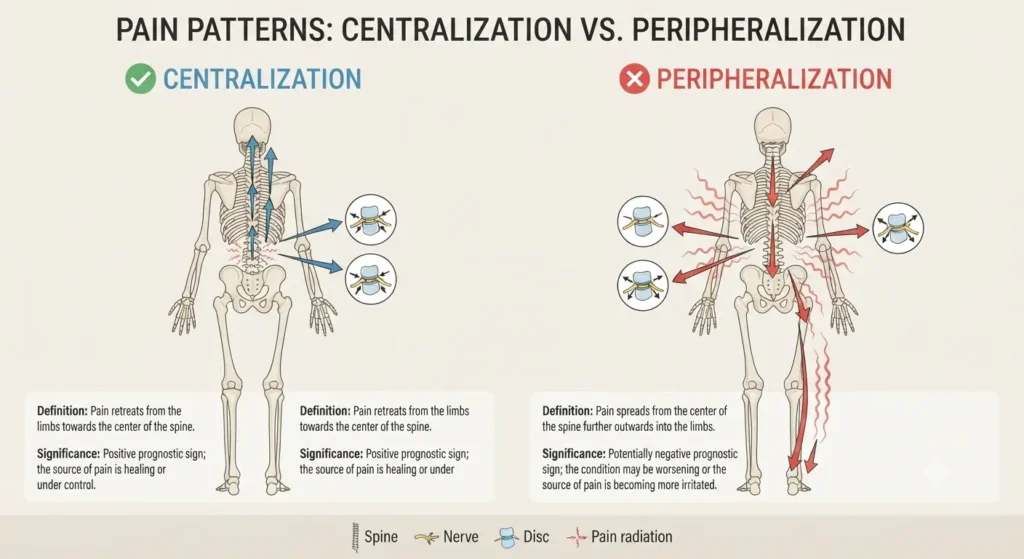
Doctors and physiotherapists watch for two key patterns during non-surgical recovery. Centralization is when pain moves from the leg or arm back toward the spine – a positive sign that nerve irritation is settling down. Peripheralization is when pain, numbness, or weakness spreads further down the limb, suggesting the nerve is still under pressure and needs medical reassessment.
If you notice peripheralization at any point, don’t push through the exercise causing it. Inform your physiotherapist or doctor so your treatment plan can be adjusted.
Home Care That Supports Faster Healing

A few simple habits make a real difference during non-surgical recovery. Back sleepers benefit from a pillow under the knees, while side sleepers should keep a pillow between the knees to maintain spinal alignment through the night. Firm, supportive chairs are better than soft couches, which encourage slouching and increase disc pressure.
Gentle extension exercises like the prone press-up – lying on your stomach and gently pressing the upper body up while keeping the hips relaxed – are commonly used for lower back herniations, but should always be guided by your physiotherapist based on your specific case. Modern guidelines also discourage extended bed rest, since gentle movement supports circulation and healing better than immobility.
Surgical Recovery: What to Expect After a Procedure
When conservative treatment doesn’t relieve symptoms after 6 to 12 weeks, or when there are progressive nerve-related symptoms, surgery may be recommended. The two most common procedures are lumbar microdiscectomy for lower back herniations and ACDF, or Anterior Cervical Discectomy and Fusion, for neck herniations. Their recovery timelines differ quite a bit.
Lumbar Microdiscectomy Recovery
This is a minimally invasive procedure, and because surrounding muscles and ligaments aren’t significantly disturbed, initial recovery is relatively quick. Most patients are encouraged to walk within hours of surgery and are typically discharged the same day or the next day.
The first two to four weeks focus on wound healing and protecting the repaired area. Traditional guidance restricted bending, lifting, and twisting for up to six weeks, but recent clinical research has shown that a shorter two-week restriction period produces similarly good outcomes for patients with smaller disc defects, while patients with larger, uncontained herniations still benefit from a longer six-to-eight-week precaution period to reduce the risk of re-herniation.
ACDF (Neck Surgery) Recovery
ACDF involves removing the damaged disc and placing a bone graft or cage to fuse the adjacent neck vertebrae. Because this requires the bone to actually fuse together, recovery follows the biological timeline of bone healing rather than just soft tissue healing.
Patients often experience temporary side effects like a sore throat, mild hoarseness, or difficulty swallowing in the first one to two weeks, since the procedure is done through the front of the neck. A soft or rigid collar is usually worn for several weeks to protect the fusion site. Full bone fusion typically takes three to six months, though many patients feel significant relief from arm pain within days of surgery. It’s the numbness and tingling that can take the longest, sometimes up to a year, to fully settle as the nerve gradually heals.
Wound Care After Surgery
removal, with the skin closed using adhesive strips that fall off naturally within one to two weeks. Showering is generally safe 24 to 48 hours after surgery as long as the incision is covered, but soaking the wound in a bathtub, hot tub, or pool should be avoided until your surgeon confirms the incision has fully closed.
Keep the area dry and clean, and avoid applying any lotions, oils, or ointments directly on the incision unless specifically advised by your surgical team.
Warning Signs During Recovery – When to Call Your Doctor
Most recoveries go smoothly, but certain symptoms need immediate medical attention rather than waiting it out. These include fever, chills, or persistent sweating, increasing redness, swelling, warmth, or discharge from the surgical site, severe headaches that worsen when sitting or standing and improve when lying flat, new or worsening numbness, tingling, or weakness in the arms or legs, and loss of bladder or bowel control.
According to the NIH’s clinical overview of disc herniation, progressive neurological symptoms or loss of bladder or bowel control can indicate a rare but serious condition called cauda equina syndrome, which requires urgent surgical evaluation. This is one of the few situations where waiting is not advisable. If you notice these specific symptoms, seek medical care immediately rather than scheduling a routine follow-up.
What Affects How Fast You Recover
A few factors consistently influence recovery speed, regardless of whether treatment is surgical or non-surgical. Age and fitness level matter, since younger, more active patients tend to recover more predictably. The size and type of herniation matters too, as smaller, contained herniations generally heal faster than larger, uncontained ones.
Consistency with physiotherapy makes a real difference, since patients who follow through with prescribed exercises recover more reliably than those who skip sessions. Lifestyle factors like smoking, excess body weight, and prolonged sitting can all slow healing, while early, guided movement rather than prolonged rest after both non-surgical treatment and surgery is linked to smoother recovery.
Conclusion
The herniated disc recovery timeline isn’t a single fixed number – it’s a biological process that unfolds in stages, whether you’re healing naturally or recovering from surgery. Most patients see meaningful improvement within 6 to 12 weeks of non-surgical care, while surgical patients often return to daily activities within a few weeks, with full internal healing continuing for several months afterward.
Understanding these phases helps set realistic expectations and makes it easier to recognize what’s normal progress versus what needs medical attention. If your pain isn’t following the expected pattern of improvement, or you notice any of the warning signs above, don’t wait, as a timely consultation can make a meaningful difference in your outcome.
For a personalized assessment of your recovery timeline, consult Dr. Tarak Patel at IndoSpine Hospital, Ahmedabad.